Christian Discernment in the Age of AI Slop: Why Reposting Fake News Hurts Our Witness
Before you repost, ask whether you are about to help a lie travel farther than the truth.

“You shall not spread a false report. You shall not join hands with a wicked man to be a malicious witness.”Exodus 23:1 ESV
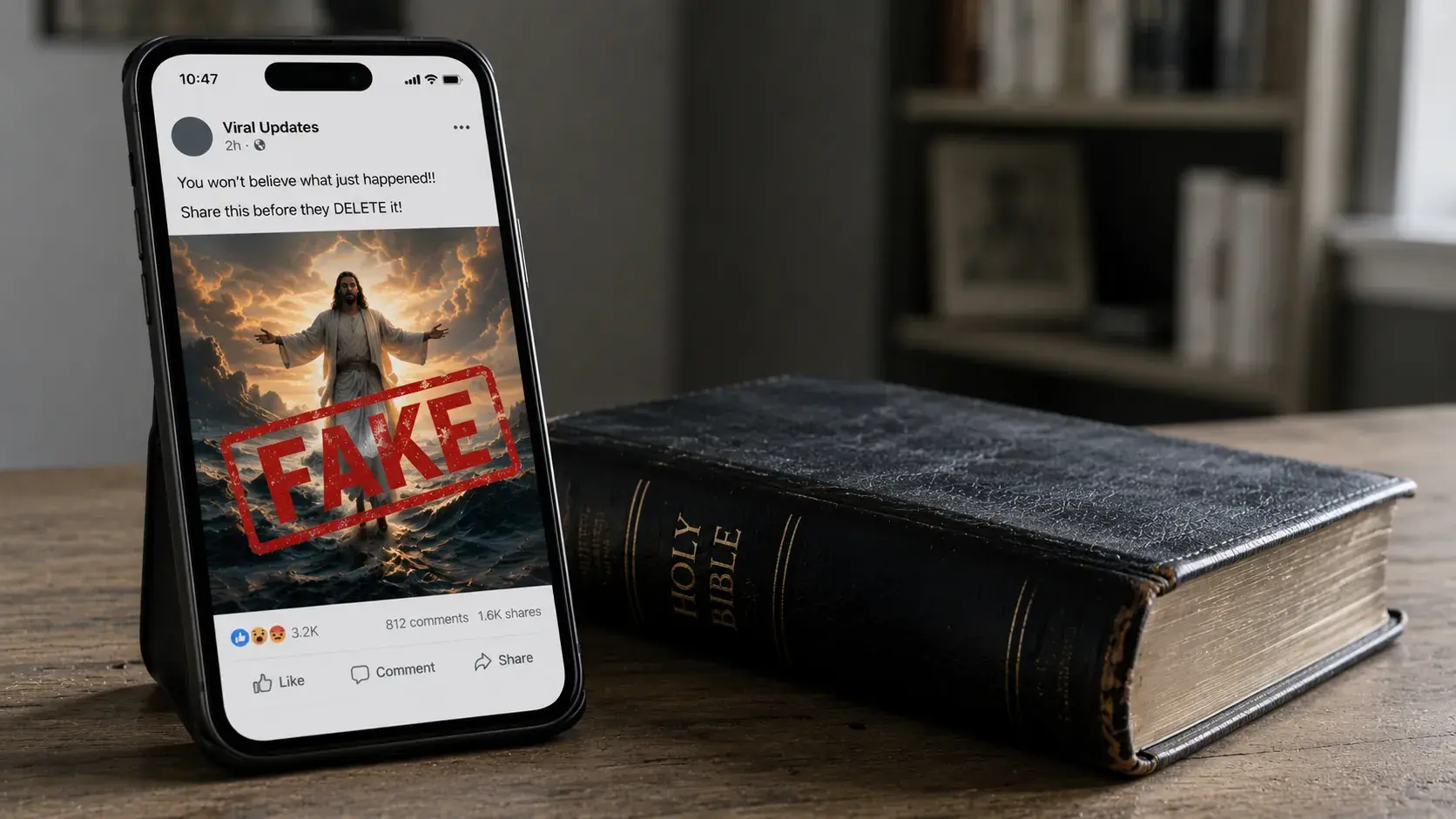
Somebody sends you a post.
It has the right enemy. The right outrage. The right kind of shocking photo. Maybe it says a politician admitted something evil. Maybe it says a celebrity mocked Christians. Maybe it has a picture of a child, a soldier, a pastor, a burning church, or Jesus standing in the clouds over Washington, D.C.
And it feels true.
That is the problem.
Not that it's true. Not that it has been checked. Not that the person posting it has a source that can survive ten minutes of scrutiny. It just feels like the kind of thing that would be true. So we share it.
Then three hours later, or three days later, someone points out that the image was AI-generated. The quote was fake. The video was clipped. The old news story was from another country. The "breaking" event never happened.
And everybody moves on.
Except they don't.
They file it away.
They remember that you shared it. They remember that you sounded certain. They remember that you wrapped it in Christian language. And the next time you post something serious, even something true, something biblical, something about sin or judgment or grace or repentance, some of them have already learned to turn the volume down.
That's not a small thing.
AI Slop Is Not Just Annoying
"Slop" became mainstream because people needed a word for what their feeds had become. The Associated Press reported that Merriam-Webster chose "slop" as its 2025 word of the year, defining the new digital sense as "digital content of low quality" usually produced in quantity by artificial intelligence.
That's a polite dictionary way of saying the internet is being flooded with junk that looks close enough to real to make you pause, react, share, and argue.
And some of it is funny. I know. A few years ago, a weird AI picture had obvious clues. Too many fingers. Strange teeth. Words that looked like cereal spilled across a sign. You could spot it.
That window is closing.
Now the content is better, faster, cheaper, and aimed directly at the parts of us that react before we think. Outrage. Fear. Sympathy. Political loyalty. Religious sentiment. Tribal disgust.
The feed doesn't need you to know. It needs you to move.
That is why this is a Christian discernment issue before it is a technology issue.
The New Bait Knows Church People
Stanford researchers looked at Facebook pages using AI-generated images for audience growth and documented more than 100 pages that had each posted at least 50 AI-generated images. Their examples included the now-famous "Shrimp Jesus" images and other surreal religious pictures. The point was not always ideology. Sometimes it was traffic. Sometimes it was product sales. Sometimes it was building an audience that could be used later.
That should get our attention.
Not because every weird Jesus picture is the end of civilization. Breathe. Some of it is just tacky internet junk.
But religious imagery works because it touches something real in people. A lonely widow sees a glowing Jesus picture with "Amen if you love the Lord" and she comments. A Christian sees a fake story about persecution and shares it because he wants to stand with the church. A politically angry believer sees a fabricated quote from the other side and thinks, "That sounds exactly like them."
And the machine learns.
It learns what makes Christians stop scrolling. It learns what gets our amens, and what gets our anger. And it learns what makes us feel like warriors for truth while we are helping a lie travel.
This is not theoretical anymore. WIRED reported in January 2026 that religious communities were being hit with AI deepfakes impersonating pastors and ministers, including fake videos asking for donations and spreading deceptive messages. That's not some far-off secular problem. That is aimed straight at the church.
The bait has learned our language.
Falsehood Already Runs Faster Than We Do
Years before the current AI flood, researchers at MIT studied false news on Twitter. Their findings were sobering. False news spread farther, faster, deeper, and more broadly than true news. False stories were 70 percent more likely to be retweeted than true stories, and true stories took about six times longer to reach 1,500 people.
The part that should bother us most is this: it was not mainly bots.
It was people.
Humans spread the falsehood. We did. We liked the novelty. We liked being first. We liked the surprise and disgust. We liked the feeling of knowing something other people did not know yet.
Now add AI.
AI didn't invent the sinful impulse. It industrialized the supply.
That means the Christian problem is not merely, "How do we spot bad technology?" The deeper question is, "Why are we so ready to believe what flatters our side, confirms our fear, and condemns our enemies?"
That question is older than the internet.
This Is a False Witness Problem
The Ninth Commandment says:
"You shall not bear false witness against your neighbor." Exodus 20:16
Exodus 23 presses the same command into public life.
"You shall not spread a false report." Exodus 23:1
Notice the wording. It doesn't say, "You shall not originate a false report." It says do not spread one.
That matters.
Most Christians who share false stories online are not sitting in a basement inventing them. They are passing them along. They are circulating them. They are giving them oxygen, adding credibility by attaching their name, reputation, church, and Bible verses to them.
That's not harmless.
Bearing false witness is not only lying under oath in a courtroom. It is participating in false testimony against your neighbor. It is helping a wrong claim injure a real person, a real church, a real public official, even a real enemy made in the image of God.
Yes, even your enemy.
Especially your enemy.
Jesus did not say, "Love your enemies unless a fake quote makes them easier to hate."
"But I Didn't Know It Was Fake"
That matters. Intent matters.
Misinformation and disinformation are not the same thing. One may be shared ignorantly. The other is shared knowingly. A Christian who gets fooled is not the same as a propagandist who manufactures deception.
But ignorance doesn't make the damage disappear.
If I hand you a cup and tell you it's clean, but it has poison in it, my sincerity doesn't heal your stomach. If I share a false accusation against a pastor, politician, teacher, church, school board member, or neighbor, the fact that I didn't create it doesn't undo the harm.
There is a kind of carelessness that becomes culpable because we had reason to slow down and refused.
Proverbs says:
"The one who states his case first seems right, until the other comes and examines him." Proverbs 18:17
That's social media in one verse.
The first post seems right. The first clip seems right. The first screenshot seems right. Then the other side comes. Then the context comes. Then the date comes. Then the full video comes. Then the correction comes.
But the correction never travels like the lie.
And by then, we have already helped the lie do its work.
The Failed Prophet Problem
This is where the witness issue gets sharp.
When a man claims to speak for God and his prophecy does not come true, Scripture does not shrug. Deuteronomy 18 says that when the word does not come to pass, the prophet has spoken presumptuously. "You need not be afraid of him."
In plain terms, stop treating him like a reliable voice.
Now, I am not saying your Facebook repost is the same thing as holding the office of a prophet in Israel. That would be sloppy Bible handling.
But the credibility principle is real.
When someone repeatedly says, "God told me this would happen," and it doesn't happen, people stop listening. They stop fearing his words. They stop leaning in. Eventually, even if he says something true, the room has already learned how to ignore him.
Our feeds can train people the same way.
If we keep posting fake news, fake AI images, fake quotes, fake crime stories, fake persecution stories, fake political rumors, and fake prophetic timelines, people will stop listening to us. Not just on that subject. On everything.
They will not say, "Well, David was wrong about that AI-generated photo of a politician, but I'm sure his claims about the resurrection are worth serious attention."
Maybe they should make that distinction.
Often they won't.
They will simply think, "He shares junk."
And then, when you post about Christ crucified and risen, you are speaking through a reputation you helped damage.
That doesn't make the Gospel less true. Nothing can make the Gospel less true. Christ does not rise or fall on my credibility.
But my witness can become harder to hear.
We Are People of Good News, Not Useful Rumors
The Christian faith is built on truth in history.
Paul does not preach a spiritual mood. He preaches events.
Christ died for our sins. He was buried. He was raised on the third day. He appeared to witnesses. If Christ has not been raised, our preaching is vain and our faith is vain.
That's 1 Corinthians 15.
Christianity is not allergic to evidence. It depends on reality. It says God acted in time, in space, in flesh, under Pontius Pilate, outside Jerusalem, in a tomb that was found empty.
So why would people who believe that become casual with truth everywhere else?
Why would we share what we have not checked? Why would we excuse falsehood because it helps our side? Why would we baptize rumor with "just saying" and "if true" and "big if" after we have already done the emotional damage?
"If true" is not a magic spell.
Sometimes it's just a cowardly way to spread something you know you have not verified.
I have done this in my own heart even when I did not hit share. I have wanted the ugly story to be true because it would make my anger feel righteous. I have seen a claim and thought, "That figures," before I thought, "Is it true?"
If people learn that your feed is careless with earthly truth, do not be shocked when they stop trusting you with eternal truth.
That's not discernment.
That is my flesh enjoying a snack.
AI Makes Discernment Harder, But Not Impossible
Pew Research found that relatively few Americans get news from AI chatbots at least sometimes, about 9 percent in an August 2025 survey. But among those who do, about half said they at least sometimes come across news there that they think is inaccurate. A third said it is generally difficult to determine what is true and what is not.
That's just chatbots. Add synthetic images, fake audio, deepfake videos, repost farms, content scrapers, political accounts, monetized outrage pages, and our own willingness to believe what fits, and the problem gets heavier.
There are tools. Use them.
Google has been adding "About this image" and C2PA-related signals to help people see whether an image was created or edited with AI tools. C2PA Content Credentials are meant to function like a history label for digital media. Reverse image search can still help. Searching the exact quote can help. Looking for original sources can help.
But no tool will make discernment automatic.
Google itself says there is "no silver bullet solution" for all content online. That's a rare statement of sanity from Silicon Valley.
No silver bullet.
So Christians need habits.
A Discernment Rule Before You Repost
Before you share the shocking thing, slow down.
Ask a few plain questions.
Who is the original source? Not the person who shared it with fire emojis. Not the account that screenshotted someone else's screenshot. Where did it start?
Can I confirm it from a reliable source outside my tribe? If only partisan accounts, anonymous pages, or engagement farms are carrying it, treat that as a warning light.
Is the date real? Old stories get recycled constantly. Sometimes the story is true, but not new. Sometimes it happened in another country. Sometimes the context changes everything.
Is the quote exact? Search the phrase. Look for full video. Look for transcript. A clipped sentence can be technically real and still function as a lie.
Is the image or video traceable? Use reverse image search. Try Google's image tools. Check whether reputable outlets have confirmed it. Look for obvious AI marks, but do not trust your eyes too much. The fakes are getting better.
Would I post the correction with the same energy? This one hurts. If I would blast the accusation but whisper the correction, I am not being truthful. I am being tribal.
Does sharing this help me love my neighbor? That does not mean we never expose evil. We should expose evil. But there is a difference between exposing darkness and forwarding bait because it feels good.
If you cannot answer those questions, wait.
You're allowed to wait.
You're allowed to not be first.
You're allowed to say, "I don't know yet."
That sentence would heal a lot of the internet.
What Repentance Looks Like Online
If you shared something false, don't hide behind the algorithm.
Say it plainly.
"I shared this earlier. It appears to be false. I deleted it. I should have checked before reposting."
That's not complicated.
Do not just delete it and hope nobody noticed. Do not post a vague "apparently this is disputed" when it has been debunked. Do not blame "the media" for your own careless share. Do not say, "Well, even if this one was fake, it shows what they are like."
No.
That is how lies keep their power after they die.
If it was false, say it was false.
If you sinned, confess it.
If you harmed someone, repair what you can.
Repentance in digital form looks like dragging the correction into the same room where the lie did its work.
Christians Should Be Harder To Fool
Not because we are smarter.
We are not.
Christians can be as gullible, angry, vain, frightened, and lazy as anyone else. Sometimes more so, because we can mistake our certainty for faith and our suspicion for discernment.
But Christians should be harder to fool because we are not left to our own instincts.
Jesus said:
"When the Spirit of truth comes, he will guide you into all the truth." John 16:13
James says:
"If any of you lacks wisdom, let him ask God, who gives generously to all without reproach, and it will be given him." James 1:5
Discernment is wisdom. The Spirit in us is not a lesser Spirit than the Spirit who rested upon Christ in His earthly ministry. We are not indwelt by Holy Spirit Jr. The weakness is never in Him. The weakness is in us. In our unbelief, our haste, our flesh, our failure to yield.
So if a man or woman is truly seeking God, walking in righteousness, asking for wisdom, yielding to the Spirit, and standing in the perfect will of God, deceit does not get to share the room. The perfect will of God and deception cannot coexist.
The problem is that I am not always there.
That is the part we need to admit before we post.
The Spirit may be warning me, and I may be rushing past Him. He may be restraining me, and I may be calling my impatience courage. He may be pressing me to wait, and I may be letting the old man grab the phone and type before the new man has prayed.
We know the heart is deceitful. We know Satan is a liar. We know false teachers exist. We know crowds can be wrong. We know our own flesh wants to justify itself. We know partiality corrupts judgment. We know the tongue can set a forest on fire.
James was not thinking about AI slop when he wrote about the tongue.
But the principle did not expire when the keyboard arrived.
"The tongue is a fire." James 3:6
Your thumb can carry that fire now.
So can mine.
So maybe the first discernment rule is not, "Can I verify this?"
Maybe the first discernment rule is, "Have I prayed until I am willing for God to kill this post?"
Before we repost, we should ask the Lord to put us where we ought to be. In His will. Under His Word. Yielded to His Spirit. Not outside His will, asking Him to bless a reaction we already decided to have.
The Witness We Are Burning
The church does not need to become paranoid. That is not the call.
We do not need to spend our lives as unpaid fact-checkers for every dumb thing on Facebook. We do not need to treat every grandmother who got fooled by an AI picture like she is part of a conspiracy. We need patience with one another.
But we also need to tell the truth.
Careless reposting hurts our witness because it teaches people that Christians can be manipulated by the same tricks as everybody else.
It teaches them that we care more about winning than truth.
It teaches them that "discernment" is just the word we use when we distrust the people we already disliked.
And eventually, it teaches them to stop listening.
That's the part we do not want to face.
We want to think every post stands alone. It doesn't. A public life has a memory. A feed has a reputation. A witness has weight or it doesn't.
If your feed is full of false alarms, do not be shocked when people stop running when you ring the bell.
If your prophecies never come true, do not be shocked when people stop fearing your prophetic voice.
If your political outrage keeps turning out to be fake, do not be shocked when people assume your spiritual urgency is just more of the same.
That is not persecution.
That is consequence.
Tell the Truth Slowly
The world is not short on speed.
It is short on truth.
Christians do not need to be the fastest people online. We need to be the people whose words have been made slower by the fear of God.
Test everything. Hold fast what is good. Refuse the false report. Love your neighbor enough not to slander him, even when he is wrong, even when he is your enemy, even when the slander would help your side for an afternoon.
The Gospel is true.
So tell the truth around it.
Don't help the lie. Don't train your neighbor to ignore you.
And don't make the next Gospel conversation harder because today's fake story felt too good not to share.
Lord, make us slower than the feed.
Further Study
I’ve hand-selected these resources because they’ve been vital to my own study. Note: As an Amazon Associate, I earn a small commission from qualifying purchases at no extra cost to you. This helps anchor the mission of The Twice Found.

God, Technology, and the Christian Life
by Tony Reinke
Reinke gives Christians a biblical framework for thinking about technology without fear, naivety, or idolatry.
ADD TO YOUR LIBRARY ➔
The Age of AI: Artificial Intelligence and the Future of Humanity
by Jason Thacker
Thacker helps believers think through artificial intelligence, human dignity, truth, and ethics from a Christian worldview.
ADD TO YOUR LIBRARY ➔
About David Wyatt
David Wyatt writes about Biblical truth and its practical application in daily life from his home in central North Carolina. His work focuses on helping Christians understand and live out their faith authentically in today's world.